You finish a debrief and someone says “I just had a good feeling about her.” Nobody pushes back. The req closes on a feeling, and three months later you are running the search again. This is the conversation most hiring managers would rather skip, and skipping it is exactly why it keeps happening.
What is actually happening in that room
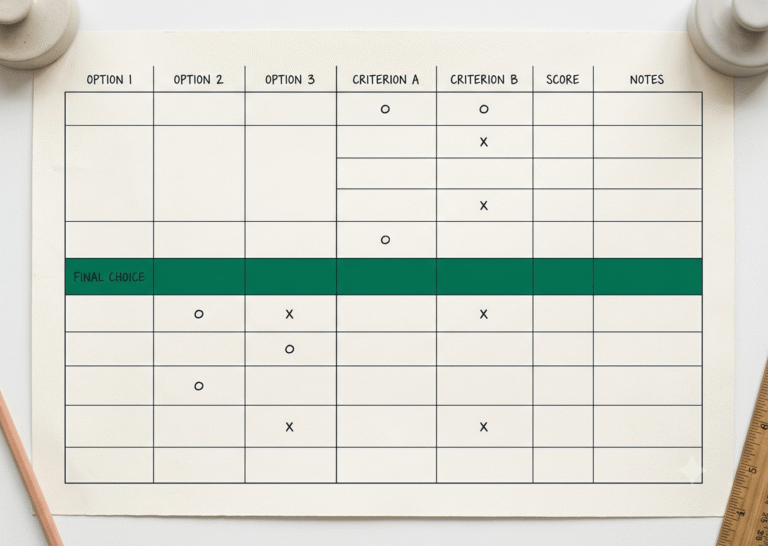
A scorecard conversation is the moment after an interview where you compare what you observed against what the role actually requires, competency by competency, instead of comparing it against how you felt walking out. Most hiring managers avoid it for one of three reasons. They were never trained to evaluate against criteria, only to react to a candidate’s presence. They worry that structure will make them seem rigid or bureaucratic. Or they already have a gut answer and structure feels like it just slows down a decision they have made.
None of those reasons hold up once you see what the alternative costs. An unstructured debrief produces unstructured hiring, and unstructured hiring is expensive. The average cost-per-hire is $5,475 (SHRM 2025 Benchmarking Report), and that number does not include the cost of redoing the search when the hire does not work out.
The real cost of skipping it
When a hiring manager avoids the scorecard conversation, three things happen in sequence. First, the evaluation criteria shift candidate to candidate, so the person interviewed last gets compared to a different standard than the person interviewed first. Second, the loudest voice in the debrief wins, regardless of whether that person actually has the most relevant evidence. Third, and most damaging, nobody can point to specific behavioral evidence when a hire goes wrong, so the team never learns what to adjust for next time.
Compare that to what a structured scorecard conversation produces. Every interviewer rates the same six competencies against the same behavioral anchors. Disagreement becomes visible and specific instead of vague and personal. And when you do make a mistake, you can trace exactly which competency was overrated and fix your process, not just your luck.
How to actually run the conversation
You do not need a complicated system to fix this. You need every interviewer to walk into the debrief having already done the hard thinking alone, on paper, before group dynamics can influence them. Here is the sequence that works:
- Score independently first. Every interviewer fills out their evaluation before the debrief starts, never during it. If people score live in the room, the first opinion spoken anchors everyone else’s.
- Rate against behavioral anchors, not impressions. For each competency, score one through five against a written description of what a one looks like and what a five looks like. “Strong communicator” is an impression. “Walked through a conflict with a stakeholder using specific examples and a clear resolution” is evidence.
- Require a justification for every recommendation. Strong yes, yes, no, or strong no, each with a one or two sentence reason tied to something the candidate actually said or did.
- Compare scores before discussing feelings. Open the debrief by looking at where interviewers agree and where they diverge. The divergence is where the real conversation needs to happen.
- Resolve disagreement with evidence, not seniority. The person with the most specific behavioral example should carry more weight than the person with the most tenure or the loudest opinion.
This works whether you are evaluating for role specific knowledge, problem solving, communication, leadership and ownership, culture alignment, or adaptability. The competencies change by role. The discipline does not.
What changes once this is in place
Before structure, a debrief is a conversation about how everyone felt. After structure, it is a conversation about what everyone observed. The decision still gets made quickly, often faster than an unstructured debrief, because there is no need to relitigate impressions when the evidence is already on the table. Hiring managers stop dreading the conversation because it stops being a confrontation and starts being a comparison of notes. The candidate experience improves too, because interviewers asking pointed, competency-based questions read as more credible than interviewers asking whatever comes to mind.
The teams that get this right are not smarter than the teams that do not. They just stopped relying on memory and feeling to make a decision that deserves better evidence than that.
This is one of the tools built into The Persiva Method, ready to use without building it yourself. The interview scorecard, with all six competencies and behavioral anchors already written, is included starting at the Playbook tier.